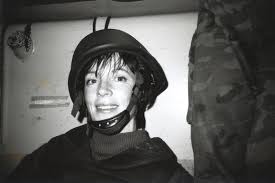
She went to dangerous places to give a voice to people who otherwise would not be heard. She was quite simply a remarkable woman who got remarkable stories.”
– Tony Hall, director general of the BBC.
Sue Lloyd-Roberts was one of television’s most outstanding reporters.
For ITN and the BBC, fearless and resourceful, she travelled widely, reporting from war zones and exposing human rights abuses in some of the world’s most tyrannous and secretive regimes. Often she did so alone, filming her own reports and going to elaborate and daring lengths to get her stories.
In 1974, she began her career as a trainee journalist for ITN which provided news programmes for ITV and Channel 4. For ITV’s News at Ten (1975-81) she covered breaking stories; for Channel 4 News (1982-85) she often reported on environmental issues; and for Channel 4 documentaries she dealt with them at greater depth, as for instance in covering the story of Greenpeace’s ship the Rainbow Warrior.
At the start, she found that female reporters were limited in the subjects allocated to them – “the royals or the Chelsea flower show”. As she told the Sunday Times, “I remember thinking at a very early stage – if you were interested in what I was doing: campaigning, journalism, human rights – three burly men with a large camera and a big fluffy phallic microphone is not the most tactful way to interview, for example, a rape victim in a war situation.”
What made the difference was the arrival in the 1980s of handheld video cameras, which opened up the possibility of travelling alone to countries reluctant to issue visas to film crews, starting with the Soviet Union. In 1992 she joined the BBC, reporting initially on human rights abuses and environmental affairs on BBC1’s Breakfast News. As a correspondent for the BBC World Affairs Unit (1996-2006) she contributed to its series Our World, and as a freelance after that to Newsnight.
In 1997, she posed as a clothes manufacturer to expose abuses in Myanmar’s garment industry, returning in 2010 to cover the country’s election. She managed to spend a week in North Korea for a Newsnight report, Inside the North Korean Bubble, which won an Emmy award in 2011. She reported in 2000 from a Romanian orphanage where babies were for sale, and was also one of the first journalists to report on female genital mutilation. On that subject, including the hidden practice of FGM in Britain and France, she made five films: “My proudest moment as a correspondent for Newsnight was when they once ran a programme that normally lasts 45 minutes, and 44 minutes of it was devoted to FGM.”
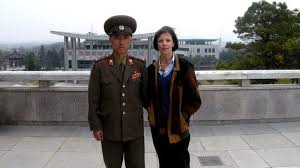
Sue poses next to a North Korean Guard in Pyongyang, 2011
In 2011, Sue was the first journalist into Homs in Syria – smuggled past checkpoints in the back of a car, with a fake ID, pretending to be the driver’s sister, deaf and unable to speak. In 1994, she reported from China on the trade in human body parts, describing how prisoners were killed to order for their kidneys and other organs. She was given a seven-year prison sentence in absentia but still went back there to report, despite the risks.
Her reports were notable for her quiet authority and occasional flashes of humour – in North Korea she joked with officials and joined in a dancing class with primary school children.
The countries her assignments took her to also included Zimbabwe, India, Lebanon, Bosnia-Herzegovina, Argentina and Peru. When it came to entering them, she used every available strategy. On arriving in Syria: “I loved acting at school, so I arrived at the border pretending to be this sort of daffy 60-year-old university don who had no idea there was a war going on: all I want to do is carry on my studies on esoteric Christian groups of the Byzantine empire. I wore a long flowery skirt and beads around my neck and acted a bit barmy, and they let me in.” She made the most of the indifference displayed by men in uniforms towards older women: “You become a Miss Marple figure.”
Illness and death
Sue was diagnosed with an aggressive form of leukaemia in 2015, and was admitted to University College Hospital in London for treatment. She publicly announced her illness on BBC 2’s Victoria Derbyshire programme in June 2015 and sought a donor from the Anthony Nolan Trust. True to form, she actively campaigned for the Trust in a bid to raise awareness of leukaemia and the need for donors to step forward not just for herself but also for the many others needing treatment.
After a nine month struggle with the disease, Sue died on the 13th October 2015.
Awards and Honours
- 1995: European Women of Achievement Award, European Union of Women (EUW), London
- 2002:Member of the Order of the British Empire (MBE) in the2002 New Year Honours for services to broadcast journalism
- 2011: Emmy Award for her reports from North Korea
- 2013: Commander of the Order of the British Empire(CBE) in the 2013 Birthday Honours for services to journalism